You want a cloud workspace
Crawls can run on demand or on a recurring schedule, and the results stay attached to the project instead of a laptop or a local export.
Backlink and research platform
We are not going to tell you we have a better link index. Nobody has a better link index.
SEO Core App covers auditing, keyword research, mapping, and rank tracking for sites you own, then deploys the corrected HTML to the live page with version history, verification, and rollback.
Written by Guillermo Velez Sanchez · Last reviewed September 7, 2026
The SEO Core App workflow
Most SEO work starts in one tool and finishes somewhere else. You find a problem in a crawl, copy the URL into a spreadsheet, write a recommendation in a document, and wait for somebody with access to the site to make the change.
SEO Core App keeps those steps together. It gives you a project for the site, a crawl that explains what needs attention, keyword and content workflows that add context, and a deployment history that makes the final change easy to review.
That is the difference these comparisons are really about. The individual tools still matter, but the useful question is what happens between finding an opportunity and seeing the improvement on the live page.
Start with the wider choice
Searching for an alternative usually means you are comparing more than a feature list. You are deciding how much technical depth you need, where the work should happen, and whether the tool can help you finish the job after the audit.
Here is the short version before we get into the details. SEO Core App is built for the full workflow. Ahrefs may be the better fit when its particular specialty is the part of SEO you spend most of your time doing.
| Tool | Best known for | Cloud and technical work | Keywords, content, and deployment |
|---|---|---|---|
| Ahrefs | Backlink and research platform | Deep technical crawl with health scoring | Very large database, clickstream-informed metrics |
| Screaming Frog | Desktop site crawler | Your desktop, while the app is open | Not included |
| Surfer SEO | Content optimization tool | Technical analysis | Yes, central to the workflow |
| SE Ranking | All-in-one SEO platform | Scheduled crawls with scored health | Volume, difficulty, and competitor keyword data |
| SEO Core App | SEO execution platform | Cloud audits, issues, and technical context | Research, mapping, content, deployment, and tracking |
Why teams look elsewhere
There is rarely one reason to compare tools. Sometimes the desktop setup has become a bottleneck. Sometimes the data is useful but the next action is still unclear. And often, the team already knows what should change but has no clean way to get it live.
SEO Core App is designed for those moments. It keeps the evidence close to the decision, then keeps the decision close to the work that follows.
Crawls can run on demand or on a recurring schedule, and the results stay attached to the project instead of a laptop or a local export.
The goal is not to hide technical detail. It is to group the findings, explain the next step, and make the important work easier to see.
Keyword Research, Keyword Mapper, Search Console data, and rank tracking give the page a reason to matter, not just a list of technical conditions.
The practical path is find, understand, prioritize, edit, approve, deploy, and track. That is the part a standalone crawler cannot complete.
The full loop
The strongest reason to consider SEO Core App is not that it has another crawl screen. It is that the crawl is one step in a longer process. Search demand gives the page context, the audit shows what is wrong, and the deployment history keeps the change safe.
Imagine a page that receives impressions for a valuable query but sits around position 14. The useful work is not finished when someone notices the opportunity. It continues until the right URL is mapped, the page is improved, the change is published, and the result is visible in tracking.
Step 1
Find queries and opportunities that match the business, not just a large list of keywords.
Step 2
Give each important query a clear URL so pages do not compete with one another.
Step 3
Check the page, its metadata, headings, links, indexability, and structured data.
Step 4
Use the available evidence to decide which issue or opportunity deserves attention first.
Step 5
Edit titles, descriptions, headings, content, internal links, or schema in context.
Step 6
Review the change, publish it through the connected deployment method, and keep the version.
Step 7
Follow the URL and keyword after the change so the work has a measurable next step.
That is why SEO Core App is better described as an SEO execution platform than as another crawler. The value is in keeping the steps connected so the last mile does not disappear into a spreadsheet, a document, or a developer queue.
A practical buying question
Pricing makes more sense when you compare the way each product is packaged, not just the number on a plan page. A desktop crawler is usually bought for the depth and control of its audit. A cloud platform is bought for the connected work around the audit.
Ahrefs is a focused choice when you mainly need its core backlink and research platform capabilities. SEO Core App is a broader SaaS workspace that combines auditing, keyword workflows, content improvements, reporting, and controlled deployments. The right model depends on whether your cost is the crawl itself or the time spent moving from a finding to a finished change.
SEO Core App paid plans currently start at $15 per month for Basic, followed by Starter at $39.99, Middle at $119.99, and Elite at $299.99. The plan page has the current capacity for projects, keywords, research, AI, and deployments, so it is the right place to check before choosing a tier.
You need its specialist capability often enough to justify the separate workflow, and you already have a reliable way to handle recommendations, publishing, reporting, and measurement.
You want one project to hold the research, URL ownership, crawl evidence, content work, deployment history, and tracking that turn SEO recommendations into completed work.
A concrete example
Imagine Search Console shows that one of your pages is getting impressions for “technical SEO audit software,” but the page is hovering around position 14. The opportunity is visible, but a ranking number alone does not tell the team what to do next.
In SEO Core App, the query, URL, crawl evidence, content work, deployment, and tracking can stay connected. That makes the example below a workflow the team can actually finish, rather than a recommendation that waits in a report.
Search Console shows the impressions, clicks, and position for the query. You can start with real performance from your own property.
Keyword Mapper associates the query with the URL that should own the intent, making the page's job explicit.
The crawler checks the title, description, headings, indexability, links, content, and structured data around that URL.
The team can see whether the query is missing from an important field, whether another URL competes with it, or whether the page needs clearer content.
Use the Content Editor or the page workflow to improve metadata, headings, content sections, internal links, or schema with the page context nearby.
Review the change, publish it through the connected deployment method, keep the version history, and track the URL and keyword after Google processes the update.
Free access
SEO Core App has a Free offer for teams that want to test the workflow on a real site before paying for more capacity. It includes one project, on demand Website Auditor, Google Search Console integration, saved and tracked keywords, and limited title and description deployments. No credit card is required.
The Free plan is deliberately sized for a focused first project, with a 500 page crawl ceiling and smaller keyword and deployment allowances. If you are evaluating a larger site or managing several projects, the paid plans add capacity instead of changing the basic workflow. You can review the current offer and limits before creating an account.
Choose by situation
The best choice depends on the work you need the tool to support every week. A technical specialist may value control above everything else. A marketing team may value a clear path from a search opportunity to a published page.
Use the examples below to recognize your own situation, then read the focused comparison sections for the tradeoffs that matter to you.
Choose the tool that matches the audit. A highly configurable desktop crawler makes sense when custom extraction and forensic work are the deliverable. SEO Core App fits when you also own the path from recommendation to implementation.
Persistent projects make it easier to keep audits, keyword maps, content work, client reporting, and deployment history together instead of rebuilding the context for every meeting.
SEO Core App is useful when the problem is not finding another issue. It is getting the issue reviewed, fixed, published, and checked without waiting for a new handoff every time.
Keep a specialist crawler when XPath, regex, log files, or unusual crawl controls are central to the work. Add SEO Core App when the team needs a governed route from findings to live changes.
A connected workflow helps when you want fewer exports and clearer next steps. The product can show what needs attention, explain why it matters, and give you a way to move the fix forward.
Before anything else
If you are deciding whether to change tools, start with the practical difference. The comparison below puts SEO Core App's workflow next to the capability you may already use, so you can see where the extra context and execution support will matter to your team.
The fit question
No SEO platform is the right answer for every team. The useful question is whether the way you work today is being held back by the crawl, by the handoff after the crawl, or by the lack of a shared place to keep decisions and changes together.
Ahrefs is better at
Everything that depends on crawling the web at scale: backlink analysis, competitor content and keyword discovery, and studying sites you have no access to.
SEO Core App is better at
Everything that depends on access to your own site: prioritizing a real backlog and publishing the fixes with version control and rollback.
Consider us if
Your Ahrefs seat is mostly used for Site Audit and Rank Tracker on your own domain, and the audit findings keep aging.
Stay with Ahrefs if
Link building, competitor research, or content gap analysis against other people's sites is central to your work.
A focused comparison
Ahrefs built a web-scale crawler and a decade of index history. That is a moat, and pretending otherwise would discredit everything else on this page.
The reference dataset for link analysis, with freshness and depth that a focused execution tool has no route to matching.
The ability to interrogate any domain, yours or a competitor's, for organic keywords, top pages, and link profile is genuinely without a close substitute.
Very large keyword databases across many countries, with clickstream-informed metrics and strong SERP history.
Ahrefs has spent years being the tool people check other tools against. That trust is earned.
Why teams choose SEO Core App
Research tells you what to do. Everything here is designed around the assumption that you then have to do it.
Crawl findings are grouped and scored by likely impact so work can be picked off the top rather than triaged by hand each month.
Keyword Mapper assigns each target intent to a specific page, with URL suggestions drawn from crawled data and Search Console query matches.
Competing URLs are surfaced and resolved as a task, rather than discovered while investigating a ranking drop.
Every deployed change is a version. You can see what changed, verify it on the live page, and undo it. Those are the same expectations you would have of code.
See it in the product
The product is easier to understand when you can see where the work happens. These are the parts of SEO Core App that support the workflow described in this article.
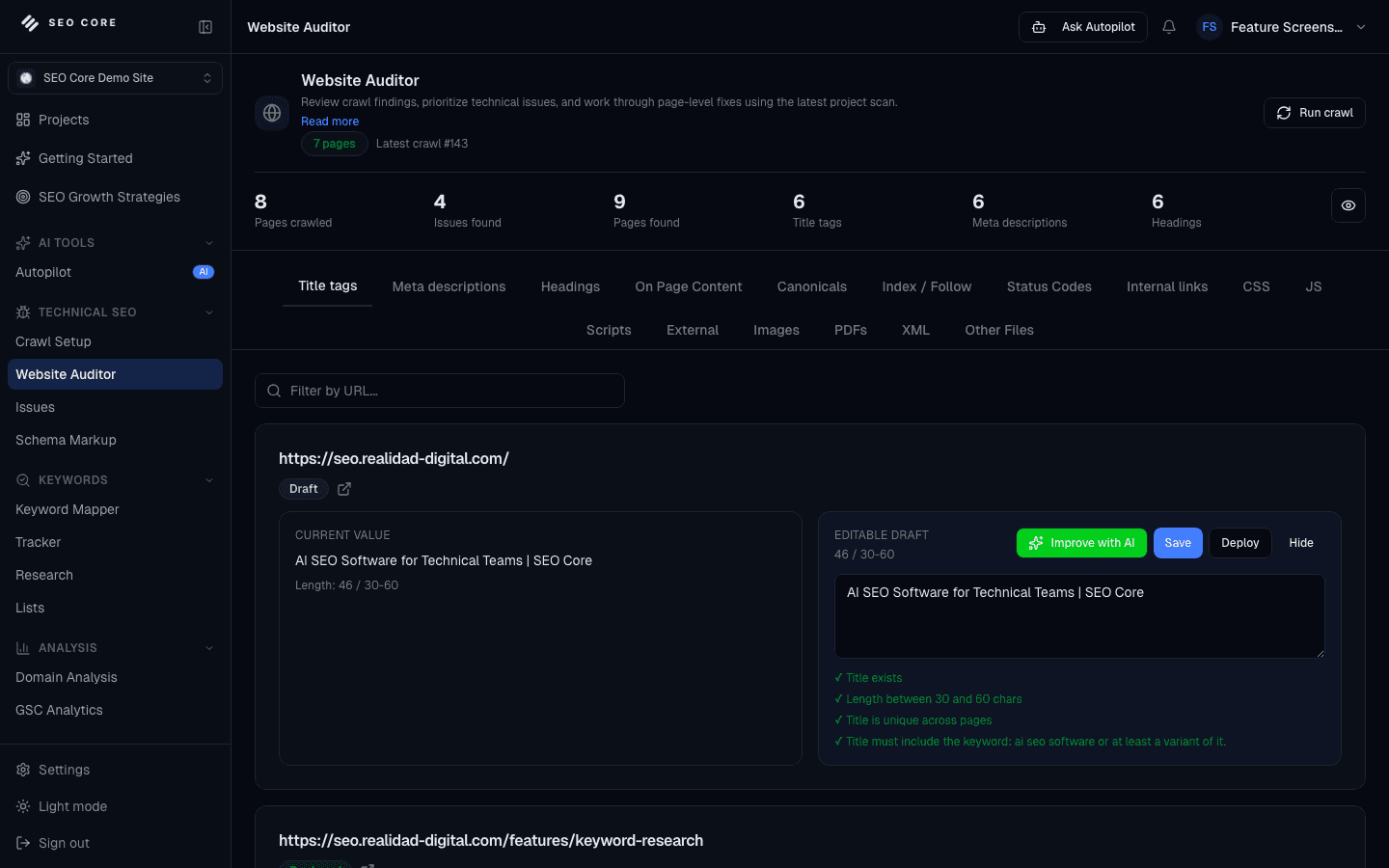
Crawl pages, review issues, and move from technical findings to safe execution.
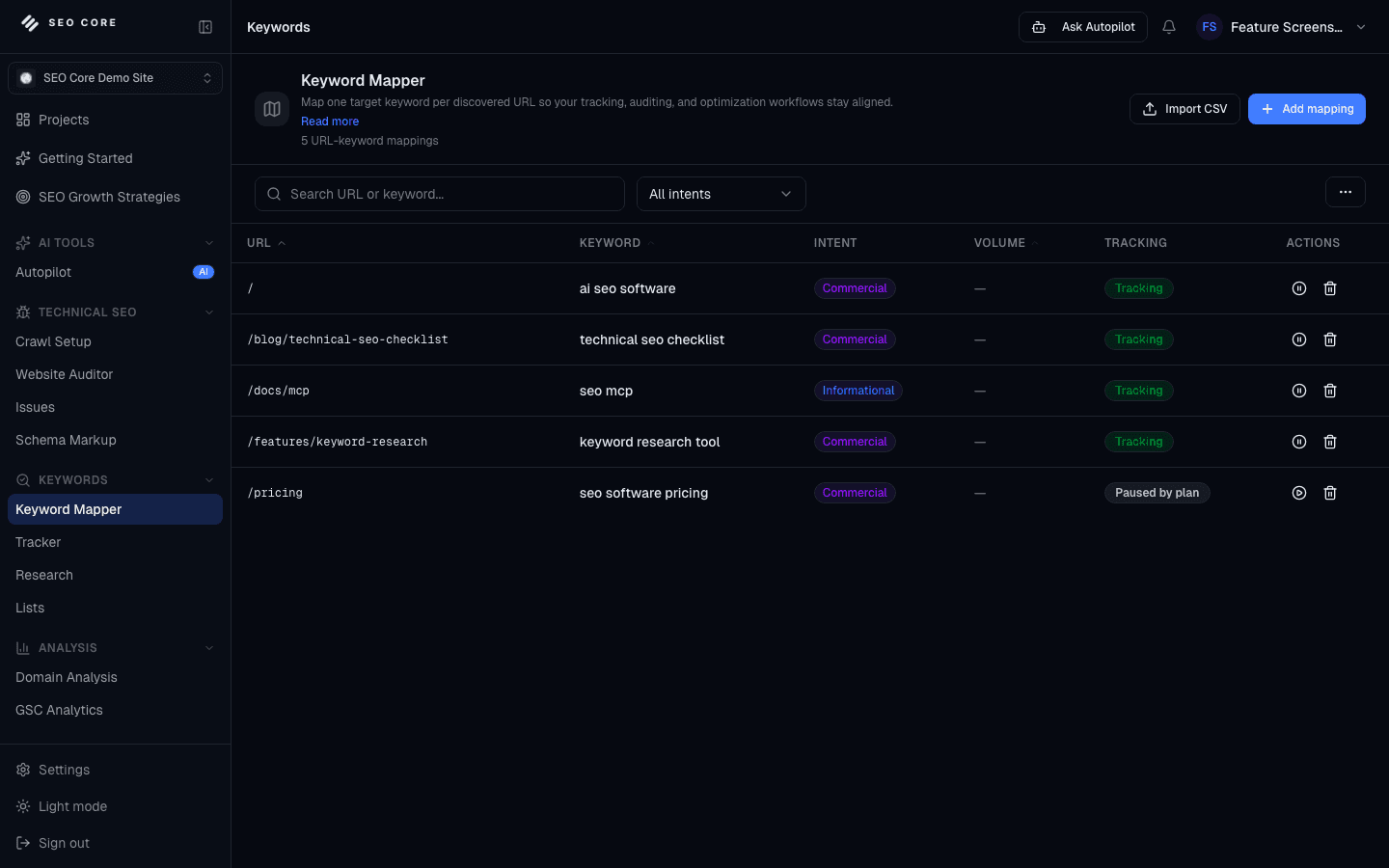
Connect search opportunities to the right URLs before execution starts.
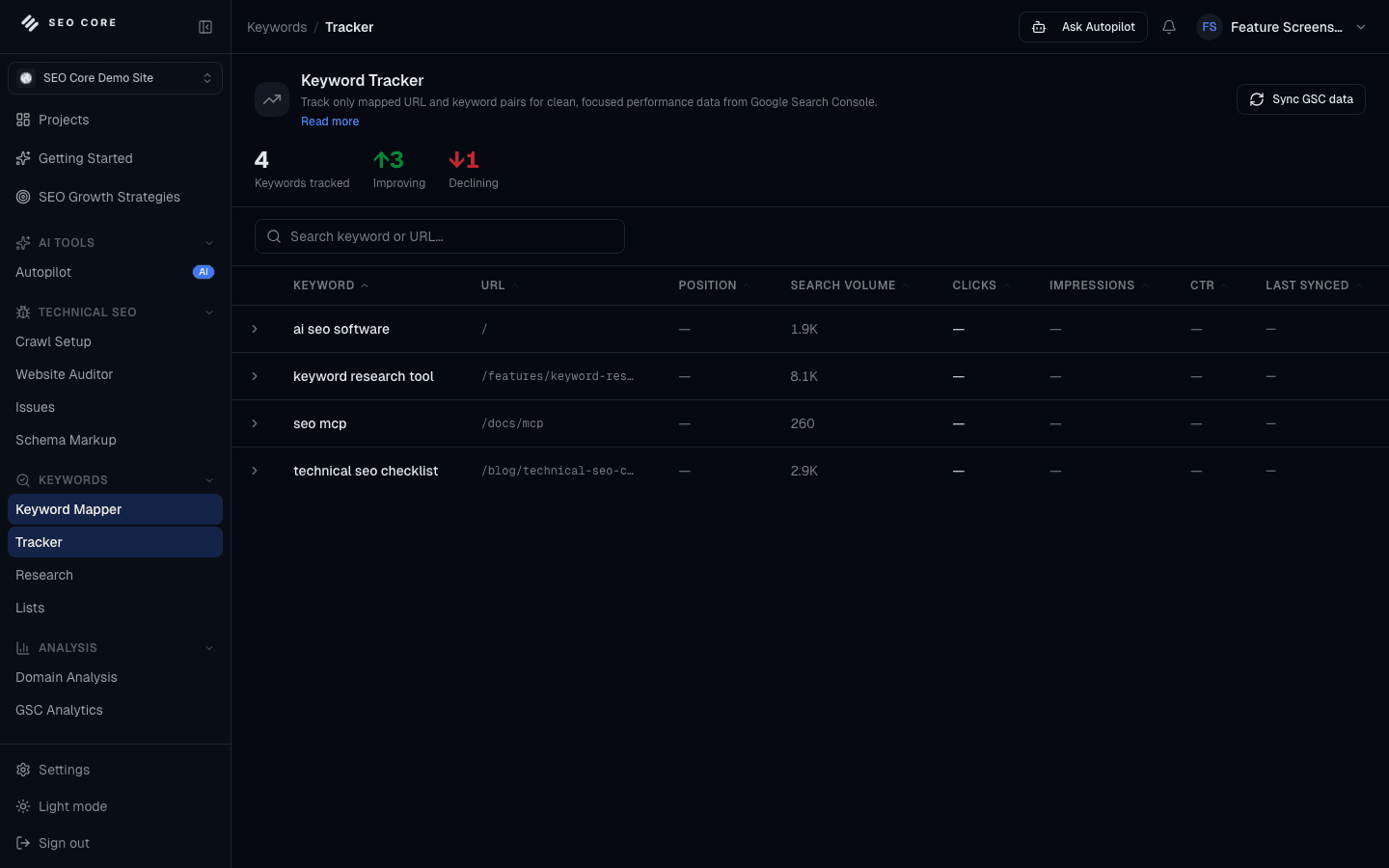
Track the right keywords and keep performance changes visible.
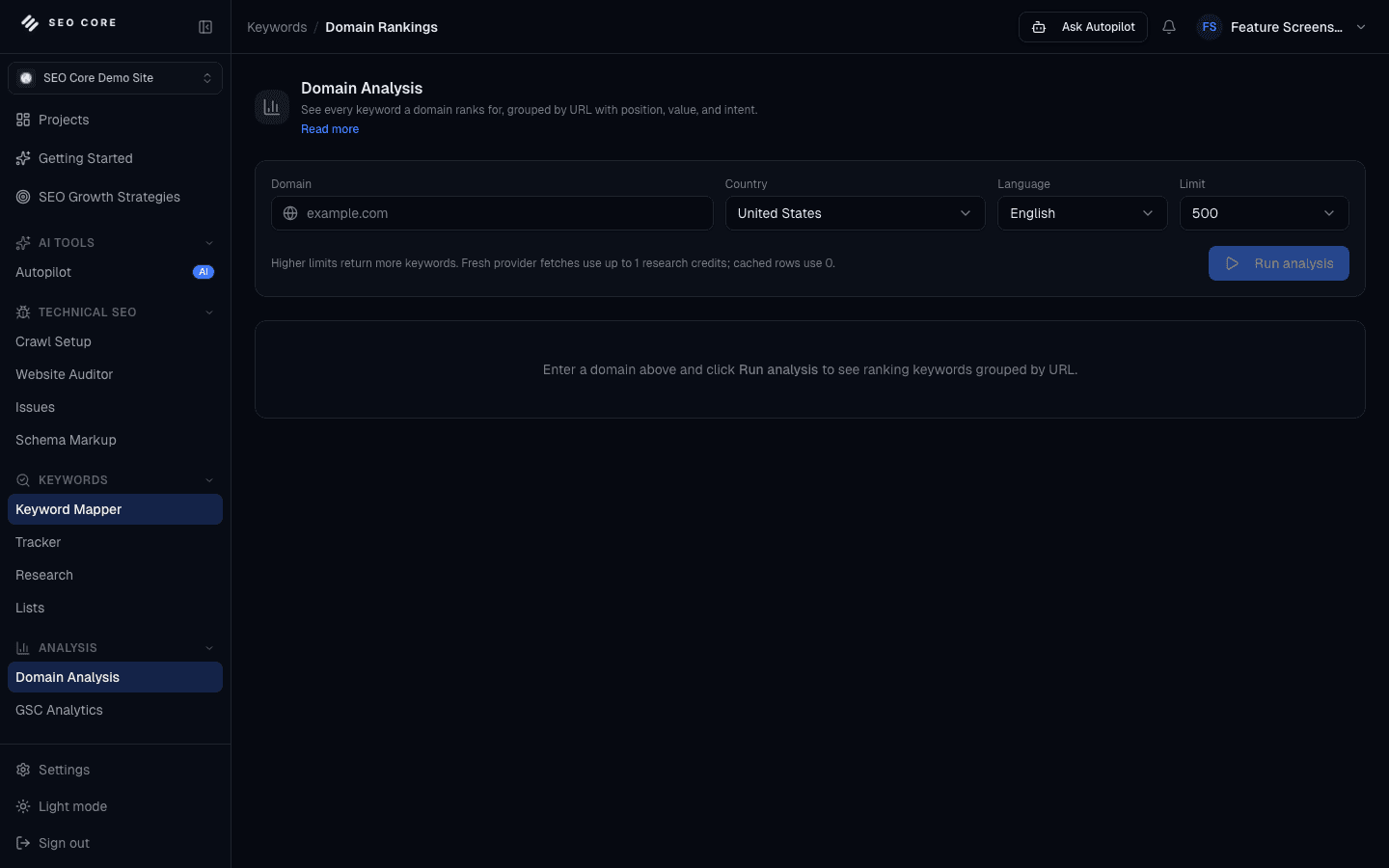
Understand where your domain can grow next with GSC and SERP context.
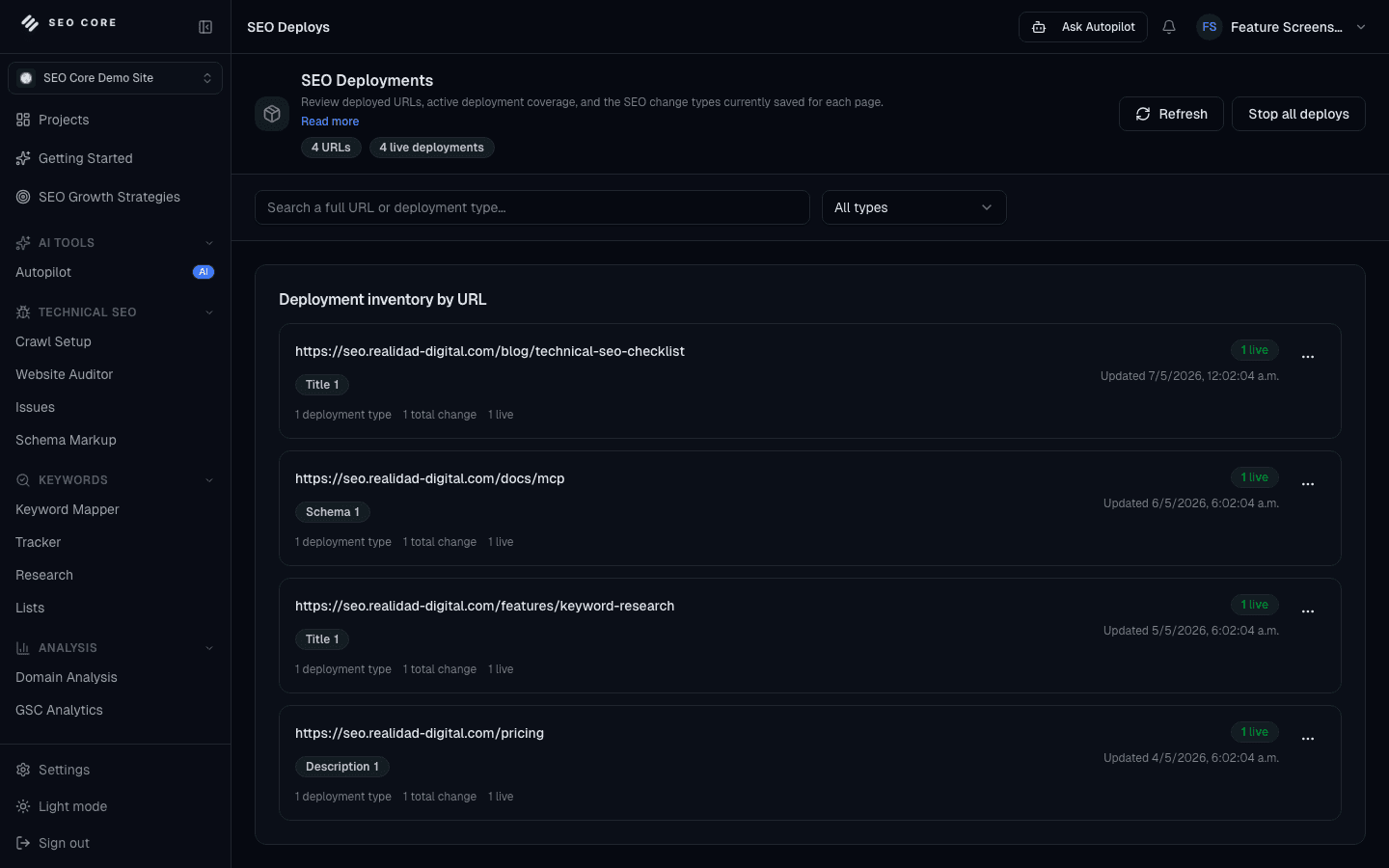
Move SEO updates live without losing governance or visibility.
Where we earn the seat
Ahrefs' Site Audit is strong and it ends where every audit ends: a list, an owner, and a wait. SEO Core App connects a deployment layer to your site so the finding can be corrected at the source.
JavaScript snippet
One script tag in the page head. Works with any site, CMS, or page builder, and it is the fastest route to a first deploy.
WordPress plugin
Server-side deployment inside WordPress. Changes land in the raw HTML output, so nothing depends on JavaScript running.
Node.js middleware
Middleware for Express, Fastify, and Next.js apps, with server-side rendering and real-time push sync.
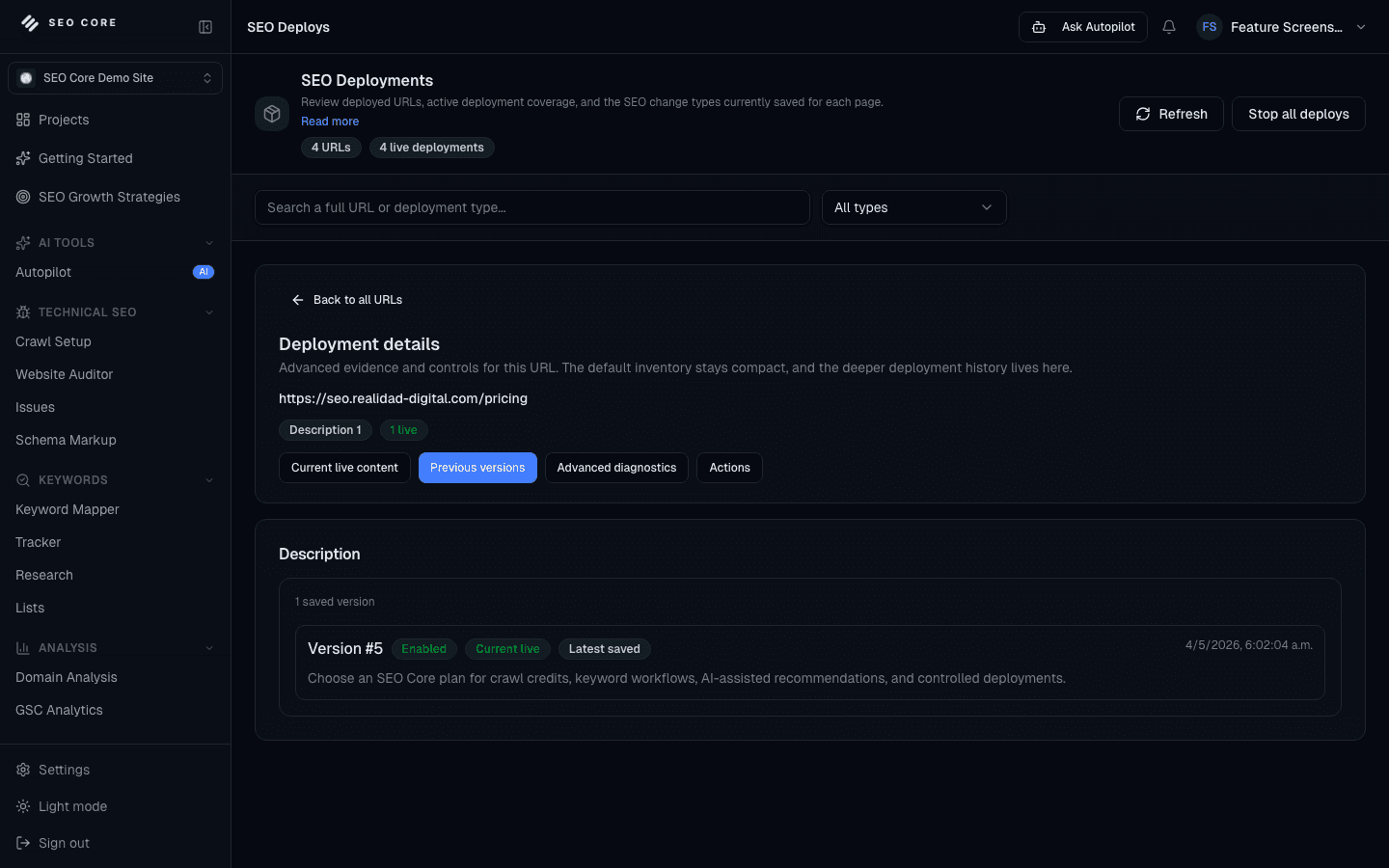
Deployable elements cover title tags, meta descriptions, H1 to H6 headings, on-page content blocks, canonical tags, and JSON-LD schema. Deployments are versioned, can be verified by fetching the live page and confirming the value is present, and can be paused per URL or rolled back completely.
Read the deployment documentationThe honest subset
Only rows where both tools do the same job for a site you own. Link and competitive research are excluded because there is no contest.
This is where the products stop looking interchangeable. A crawl or content score can point to a problem, but the team still needs context, a decision, a change, and a way to learn from what happened next. SEO Core App keeps those steps in the same project.
| Workflow step | Ahrefs | SEO Core App |
|---|---|---|
| Crawl or analyze the page | Deep technical crawl with health scoring | Website Auditor and page evidence |
| Prioritize the opportunity | Manual review or interpretation | Issues grouped by impact and project context |
| Research and map the keyword | Very large database, clickstream-informed metrics | Keyword Research, Keyword Mapper, and Search Console |
| Edit the title, content, or schema | Limited on-page tooling | Content, metadata, headings, and schema workflows |
| Publish the approved change | Not included | Connected deployment with review and version history |
| Track what changed | Extensive with SERP feature history | Rank tracking, reports, verification, and rollback |
| Capability | Ahrefs | SEO Core App |
|---|---|---|
| Site audit | Deep technical crawl with health scoring | Scheduled crawls with impact-scored issue queues |
| Keyword research | Very large database, clickstream-informed metrics | Volume, difficulty, CPC, competition, and intent, cached per location |
| Rank tracking | Extensive with SERP feature history | Tracked keywords connected to the pages that own them |
| Own-site performance data | Estimated organic traffic plus Search Console connection | Search Console query and URL evidence feeding mapping and suggestions |
| Backlink analysis | Category-defining | Not included |
| Competitor research | Site Explorer on any domain | SERP context within domain analysis only |
| Content optimization | Limited on-page tooling | Content Editor with awareness stages and heading templates |
| Publishing changes | Not included | Snippet, WordPress plugin, or Node middleware, versioned |
Do not skip this
If any of these are load-bearing in your process, this is not a replacement and you should not treat it as one.
This is the part worth reading before you switch. A broader workflow is useful only when it still fits the work you need to do, so these limits are here to make the decision easier, not to bury the tradeoff.
Backlink index
No link data, no referring domain analysis, no link-based authority metrics.
Competitor site analysis
You cannot point us at a competitor's domain and get their organic keywords and top pages.
Content gap against other domains
Gap analysis here works from your own crawl, keyword map, and Search Console data, not from other people's rankings.
Brand mention and alert monitoring
No web-wide mention tracking or alerting of any kind.
Genuinely
A good alternative page should also help you avoid a bad switch. If your weekly work looks like one of the situations below, the specialist tool may still be the more sensible choice.
In practice
Moving to a new SEO tool does not need to mean rebuilding your whole process in one day. Start with one project, bring in the evidence you already trust, and use the first workflow to decide what should become part of your regular routine.
Step 1
Pick a site you can deploy to
The advantage here is execution, so start where you hold access rather than on a client property.
Step 2
Crawl and connect Search Console
Real query data replaces estimated traffic for any property you own.
Step 3
Move your audit backlog over
Take the open findings you have been carrying and let them arrive as an ordered queue.
Step 4
Install the deployment layer
Ship one change, verify it on the live page, and decide from there whether the workflow earns its place.
Explore the product
Every capability referenced above has its own page. Start from the SEO Core App homepage for the overview, browse all features, or check what each plan includes on pricing.
Asked honestly
These questions usually come up after someone understands the product difference but before they commit to changing a working process. The answers are specific to the workflow on this page and are meant to help you make a practical call.
No. There is no link index and no plan to build one. If backlinks are part of your work, keep Ahrefs or an equivalent.
Only through SERP context inside domain analysis. You cannot pull a competitor's organic keyword set or top pages the way Site Explorer does.
Because they do different jobs. Ahrefs answers what is happening across the web. SEO Core App changes what is happening on your site, with versioned deployments you can verify and roll back.
Use the Node middleware for Express, Fastify, or Next.js, which renders server-side with real-time push sync. On WordPress the plugin writes into the raw HTML output, so nothing depends on client-side JavaScript.
Not on breadth or SERP feature history. Ours is built to connect tracked keywords to the pages that own them and to the changes you deployed, which is a different design goal.

Who wrote this comparison
Technical SEO, keyword strategy, automation, and AI-driven search visibility.
Ahrefs is the tool I check other tools against, and I say that as someone building a competitor. What I could never get out of it was a way to actually change the page, which is why this exists.
A decade working in SEO across agency and client projects, focused on turning strategy into real, measurable results. Builds scalable processes, experiments with automation and AI, and approaches SEO with a strong execution mindset. Writes about technical SEO, keyword strategy, and practical ways to grow visibility across search engines and emerging AI-driven platforms.
SEO Core App
Turn the audit findings you are already carrying into deployed, reversible changes.
Ahrefs and all other product names, logos, and brands are the property of their respective owners. SEO Core App is not affiliated with, endorsed by, or sponsored by Ahrefs. Comparisons describe capabilities at the time of review and are based on publicly available information.